


Congress is considering whether to eliminate or limit a federal tax deduction for intangible drilling costs. Intangible drilling costs are those costs incurred to develop an oil or gas well other than the costs of the actual well. It includes costs such as surveying, clearing the land for a well pad or storage tanks, drainage modifications, fuel, and workers’ wages. Current US tax law allows oil and gas companies to deduct these operating expenses from their taxes, exactly like other businesses deduct the intangible business expenses incurred in operating their business.
Understandably, the oil and gas industry is quite concerned about the potential elimination of this deduction. Elimination of this deduction would effectively make exploration, drilling and production of oil and gas more expensive. That means that there will be less exploration, drilling and production in Texas, as well as in other states. In turn, that means that some number of Texas mineral owners who hope to lease their minerals, and who may really need the royalty income, may lose that opportunity.
A coalition of 33 national, regional and state oil and gas associations sent a letter to the leaders of two key congressional committees, the House Ways and Means Committee and the Senate Finance Committee, who are dealing with this issue. Groups who signed the letter included the American Exploration and Production Council, or AXPC, the American Petroleum Institute, the Independent Petroleum Association of America and the Western Energy Alliance, as well as ten other national and two other regional associations and 17 state organizations, including some from Texas.
 The new report was written by the Chamber’s
  Devon stated it expects this move to save $80 million per year from administrative and personnel expenses. Conversely, the cost of the restructuring and reorganization will cost Devon $125 million. The company has had some problems recently, as Devon posted a net loss of $179 million in the quarter that ended on September 30, 2012. Most of that loss was due to $1.1 billion non-cash impairment charge. Devon indicated that this move will allow it to be more flexible and to quickly move its workforce to wherever it is most needed at any given time. Devon officials also expect the consolidation to increase efficiency by promoting increased sharing of best practices within the home office.
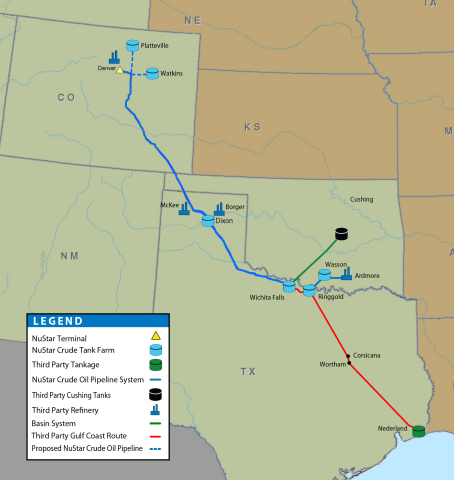 To find out what kind of interest exists for this new pipeline project, NuStar held a
  Of those surveyed, 75% think the US is already self sufficient in natural gas or will be within ten years.
  The Cardno study was part of a settlement in 2011 of a lawsuit filed in 2008 against Los Angeles County and Plains Exploration over land use.
  “If you’re looking for a job, this is the place to be. If you want to relocate, this is the place to be,” said Diane Laplow of San Antonio. There were 48,000 new jobs created by activity in the shale last year. Aside from working directly in the oil and gas industry, this boom is bringing opportunities for small business as well, creating many jobs in other sectors of the local economy. For example, people are opening family businesses, like restaurants, to feed hungry oil workers. “It’s a very good spot to start a business,” said Sarah Cadena, a native of the area whose family now owns a burger and wings joint on a busy highway.