


There is new reason to be energized (excuse the pun!) about Texas’ oil and gas industry in 2013. The last several years have been exciting in this field, and Texas has benefited from its substantial natural resources. Now recent reports indicate that oil and gas companies will spend $28 billion in the Eagle Ford shale play alone in the coming year. That money will infuse the Texas economy, create many new jobs and send billions of dollars in tax revenues to local and state government.
The Eagle Ford is the second largest tight oil play in the United States. It is fifth in the country for shale gas production and is projected to account for 15% of US onshore oil production. North Dakota’s Bakken field is still the largest unconventional oil producer. Wood Mackenzie, an energy industry research and consulting firm commonly called “WoodMac”, studied and analyzed the trends to calculate these numbers for the Eagle Ford. Callan McMahon, an upstream analyst, asserted that the Eagle Ford continues to exceed analyst expectations.
 The Eagle Ford has already shown impressive growth, going from 100,000 barrels per day of liquids such as natural gas in early 2011, to 700,000 barrels per day by December 2012. This dramatic increase is, according to WoodMac, due to technology and expertise. A lot of the money spent in the Eagle Ford this year will come from three major operators: EOG Resources, BHP Billiton, and ConocoPhilips. All three were early to focus on Eagle Ford’s liquids-rich areas, and have been rewarded. The Eagle Ford represents 38% of EOG’s upstream value, and 20% of BHP Billiton’s upstream value. According to WoodMac, in resource plays the key is core acreage. This certainly seems to hold true in the Eagle Ford. Most operators are realizing the quality of their acreage just recently. The leading companies, like the three above, not only hold core acreage positions but also own large numbers of acres in the key areas. Smaller companies are also getting in on the action by using joint venture and cost carry agreements to maximize their value per acre.
 On first blush, you may ask, why is that a problem? Consider this: There may be cities or counties within Texas that, from time to time, create restrictions so severe that all oil and gas drilling and production activity is effectively prohibited. However, most of the regulations I am aware of are eminently reasonable. For example, many city or county regulations prohibit oil wells and compressors in residential areas or next to schools. There are good reasons for this. The noise and smell of an actively pumping oil well with an above ground pump, or the noise and smell of a compressor used on a gas well (especially one without a hospital muffler), are substantial. No one could sleep or have any peace near these activities. Secondly, no matter how high the fencing around pumps and other oilfield equipment, they are going to be an attractive nuisance for kids and teenagers and serious injuries or death may result. Thirdly, the location of these activities near homes is going to result in a substantial decrease in the value of those properties. Finally, local cities and counties who have drilling and production activity in residential areas forced upon them are going to find that the diminished value of those homes is going to decrease their tax revenues at a time when they are already struggling.
 The new report was written by the Chamber’s
  Devon stated it expects this move to save $80 million per year from administrative and personnel expenses. Conversely, the cost of the restructuring and reorganization will cost Devon $125 million. The company has had some problems recently, as Devon posted a net loss of $179 million in the quarter that ended on September 30, 2012. Most of that loss was due to $1.1 billion non-cash impairment charge. Devon indicated that this move will allow it to be more flexible and to quickly move its workforce to wherever it is most needed at any given time. Devon officials also expect the consolidation to increase efficiency by promoting increased sharing of best practices within the home office.
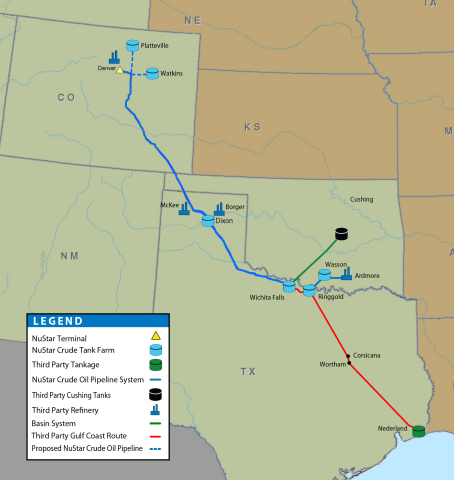 To find out what kind of interest exists for this new pipeline project, NuStar held a
  Of those surveyed, 75% think the US is already self sufficient in natural gas or will be within ten years.